
First Shloka of Shri Ramcharitmanas
वर्णानामर्थसंघानां रसानां छन्दसामपि।
मंगलानां च कर्त्तारौ वन्दे वाणीविनायकौ॥1॥Varnanaam Arthsanghanaam Rasaanaam Chandsaam Api
Manglaamaan Ch Kartrao Vande Vaani Vinaayko
भावार्थ:-अक्षरों, अर्थ समूहों, रसों, छन्दों और मंगलों को करने वाली सरस्वतीजी और गणेशजी की मैं वंदना करता हूँ॥1॥
I worship Saraswati Mata (the goddess of speech) and Ganesh ji or Vinayaka, the originators of sounds and speech represented by the alphabet, the multitudes of objects denoted by those sounds, poetic verses, and the givers of all auspiciousness.
Another translation of the first shloka as per Shri Rajendra Das ji Maharaj
सरल भावार्थ:- अक्षरों, अर्थ समूहों, रसों, छन्दों और मंगलों को करने वाली सीता जी (वाणी की देवी माता सरस्वतीजी की देवी) और श्री राम (मानस के मुख्य नायक, जिनका नाम गणेशजी सदा जपते हैं) की मैं वंदना करता हूँ॥1॥
Meaning:- I offer my reverence to Mata Sita (who is the goddess of goddess of speech; Mata Saraswati) and to Shri Ram (the main character of Shri Ramcharitmanas whose name Lord Ganesh constantly chants), the originators of sounds represented by the alphabet, of the multitudes of objects denoted by those sounds, of poetic sentiments as well as of metres, and the begetters of all blessings.॥1॥
Seven Kaands of Shri Ramcharitmanas summarized by Maharaj ji through the first shloka
Varnanaam
Varnanaam meaning Varna is a Sanskrit word with several meanings including type, order, colour, or class, and is used to refer to social classes like Brahmin, Kshatriya, Vaishya and Shudra in Hindu texts like the Manusmriti.
Bhagwan Shri Ram is Ajanma (unborn) and no one can comment on bhagwan’s caste or varna because everyone belongs to bhagwan and vice versa. Saint Kabirdas ji has also sung about this. Lord Ram has no caste or social class. Everyone has come out of him. Even though bhagat Jatayu was a meat eating bird, Ram ji respects him like his own father. Mata Shabri was a tribal woman, but Ramji treats her like his own mother. Ramji hugs Kevat, the boatman, and grants him his prime devotion. He is in everyone and everyone is in him.
There is no one as generous, kind, and merciful as Ram ji. An avatar is born as a human being to teach some lessons to mankind and all humanity. When bhagwan takes an avatar on earth, he takes birth in some varna. And then according to the varna he is born in, he adopts those sanskars (family or social traditions). In Baalkaand, Ram ji chose to be born in a Kshtriya (warrior) varna and took birth in the Ishvaaku clan.
And then as per Vedic rituals he went through all sankars in the Balkaand, like jaatkaram, annaprashan, choodakaran, karanbhed, naamkaran, and upbeet sankar. Yagyopavit and vivah sanskar are two important sankars that also take place in the Baalkaand.
Varna also means alphabets, sound, notes etc., and the process of learning to read and write is also mentioned in the Baalkaand. Ram ji from whose mouth Vedas flow effortlessly, enacts a leela (play) and becomes a lovable student of Guru Vashisht.
Arthsanghanaam
The word Arthsanghanaam implies Ayodhyakaand. The word Arthsanghanaam is made up of two words Artha (purpose) + Sangha (collection). Many purposes (pryojan) of bhagwaan’s vatar can be seen in the Ayodhyakaand. Ram ji’s leaving the comforts of his kingdom and going to the forest made him popular with the masses. Ram ji’s devotion to his father (pitra bhakti), his tyaag (renunciation), penance, vairagya (detachment), sheel (humility), sadachaar, serv sulabha (good natures and easily accessible to simple forest dwellers). His gunnas (qualities), dushtant karak (destroyer of the wicked), dharam rakshak (protector of truth), gau rakshak (protector of cows), sadhu rakshak (protector of sages), dwij rakshak (protector of Brahmins), asur sanghar (destroyer of demonic people), all these gunnas won’t have come to light without him going to forest.
According to Shri Bhagvatam by Rishi Sut Ji, Ram ji ruled for 13,000 years before his avatar left for his adobe and according to Rishi Valmiki Ramayan, Ram ji served his kingdom for 11,000 years. The difference is because of the era when these two events took place, this is called Kalpa Bhed (Kalpa is the span of the life of the universe, each kalpa has been divided into four Yugas. The acts of the Lord performed in different yugas of kalpas sometimes have difference (bhed) in the set of events, which gives rise to the term कलपभेद or Kalpa bhed).
In almost every Ramayan, 14 years of Ram ji’s exile are prominent. And Ayodhakaand sets the main purpose of Ram ji’s avatar in these fourteen years.
Arthsanghaanaam also means (Rajya + Collection) or a collection of events of a kingdom. Ram ji honours the vow made by his father to Kaikeyi mata, and chooses to go to the forest. Lakshman ji shows his devotion towards his brother by going with him and Sita ji shows her duty towards her husband by leaving with him. Bharat ji’s love for Ram ji is expressed in his renunciation of the throne. He brings Ram ji’s slippers to Ayodhya and installs them on the throne until Ram ji’s return from the forest. Bharat ji used to take all important political decisions after meditating on Ram ji’s paduka (slippers). In fact, Bharat ji’s bhakti (devotion) is hard to be described in words. Shatrughan ji’s duty towards the kingdom and running the affairs of Ayodhya kingdom as a mere caretaker until Ram ji’s return to Ayodhya after 14 years of exile, is also described in the Ayodhyakaand.
Rasaanaam
The literal meaning of rasa is joy. In Indian aesthetics, a rasa (Sanskrit: रस) literally means “juice, essence or taste”. The joy that comes from poetry is the essence of poetry. The joy that comes from the poetry in Shri Ramcharitmanas, that taste is divine, not temporal. Rasa is the soul of poetry. It has been said in Sanskrit that “Rasastakam Vakyam Kavyam” which means that the sentence containing the juice (rasa) is poetry. There are nine types of rasas in poetry and all these rasas are present across Shri Ramcharitmanas, but Aranyakaand has the most forms of rasas. श्रृंगार, हास्य, करुण, रौद्र, वीर, भयानक, वीभत्स, अद्भुत – beauty or romance, humor, compassion, anger, valour, horror, fear and wonder respectively. The principal corresponding human feelings are delight, laughter, sorrow, anger, energy, fear, disgust, heroism, and astonishment.
Ram ji expresses shaant rasa (calm) when he meets the sages and munis in Aranyakaand. When Srupnakha meets Ram ji and Lakshman ji, both the brothers express hasya rasa (humour). Fighting with demons like Kar, Dushan represents raudra rasa (anger). Ram ji displays shringaar (beauty or romance) rasa with his beloved Sita ji and many different rasas in the Aranyakaand.
The king of all rasa or rasa raaj is known to be shringaar rasa (beauty) or madhuraya rasa (romance). The lord of rasa raaj is bhagwan or Lord Ram, who is the divine everlasting beauty and love personified.
Chandsaam
Chandsaam is Kishkindhakaand. Chand means the types or styles of verse in poetry. There are infinite types of chands in poetry, so are the types, colours, and countless species of monkey and bear warriors in Kishkindhakaand whom Ram ji and Lakshman ji meet in the forest of Kishkindha.
Api
Api denotes Sunderkaand. One of the meanings of the word Api is निश्चय or Firm belief or certitude. This attribute can be seen in Sunderkaand through many examples. It can be seen in Sita ji’s words in the message she sends to Ram ji through Hanuman ji when she is in a tough situation as a prisoner in Lanka. Vibhishan’s belief in Ram ji is second only to Hanuman ji. Even Ravan got a glimpse of the power of Ram ji by witnessing the strength of Hanuman ji when he destroys Ashok Vatika, kills thousands of his warriors, including one of his sons and then burns Lanka down.
Manglanaam
Manglanaam denotes Lankakaand. Mangla means all auspicious. And all auspicious cannot prevail until the inauspicious is destroyed. And this can be seen in Lankakaand, when in order to establish Dharma, Ramji kills Ravan and his entire clan, with the exception of his brother Vibhishan who was a devotee and had surrendered to the lotus feet of Shri Ram.
Ch
Means “and”
Kartaro
Kartaro denotes Uttarkaand in Shri Ramcharitmanas which establishes karta (the doer) and his Ram Raaj that spreads auspiciousness in the three worlds.
Vande Vaani Vinayako
Naman (Obeisance) to Goddess Sita ji and Vinayak (main hero – Shri Ram) of Shri Ramcharitmanas.
Naman (Obsesaine to Goddess Sita and Vinayak (Main hero) of Shri Ramcharitmanas.
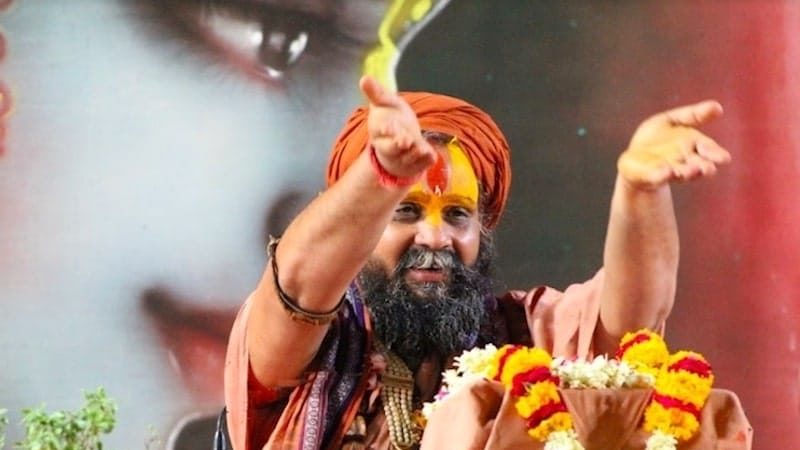
About Shri Rajendra Das ji Maharaj
Swami Shri Rajendra Das ji Maharaj is a very benevolent and a highly regarded saint who mesmerizes all devotees with his Bhagwad Pravachan and Satsang. Maharaj ji is known for reciting stories of Bhagwan’s devotees from the Bhaktmaal scripture. Plus, he also recites many other kathas that include Shri Mahabharat, Valmilki Ramayan, Shri Ramcharitmanas, Vinay Patrika, Shiv Puran to name a few. He is a very disciplined saint with prime devotion towards Lord Krishna, Kishori Ji, Shri Ram, Sita ji and Hanuman ji. Swami ji’s life mission is to protect and render service to cows in India. Under his divine leadership, more than 8,000 cows are taken care of across four Gaushalas at Shri Jadkhor Gaudham located in Rajasthan, India.